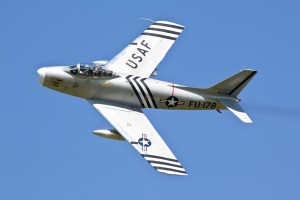
The other day I took a few friends to see some Korean-war-era aircraft at the Western Sky Warbirds Museum. We saw some vintage jets amazingly still in flying condition, and even climbed into the cockpit of a Russian-built MiG-15 fighter. Pretty cool. Naturally, it got me thinking about the business decision process.
What do jets and MiGs have to do with business? A lot actually. Stay with me here…
The 1940s and 50s saw the emergence of jet engines and new understanding of aerodynamics. New technology propelled aircraft faster and faster until they were pushing up against the so-called “sound barrier”. There was a race to be the first to fly faster than the speed of sound (won in 1947 by Chuck Yaeger and the Bell X-1). Then in 1950, the Korean War introduced the first jet-to-jet air combat engagements, otherwise known as “dogfights”.
In frigid skies over northwest Korea (aka “MiG Alley”) American F-86 Sabre jets battled Soviet-made MiG-15s for air superiority. Flying at 600-plus miles per hour in life-or-death duels, those jet jockeys had to make split-second decisions to survive and win. At jet speed, things get real intense real fast.
Among those fighter pilots was a young John Boyd, who later used his experience to come up with several ground-breaking ideas. Boyd was a maverick, a disrupter, an innovator, who loved challenging assumptions.
After Korea, he became a top tactical instructor for the USAF, and essentially rewrote the manual for air-to-air combat. He based his ideas on the observation that, even though on paper the MiG-15 had better performance characteristics, the U.S. Sabre pilots almost always won against them.
Boyd noted that the Sabre pilots’ marked superiority (a kill ratio of about 8:1 over the MiGs) was because of better training and key technological advantages that helped them see, react to and engage quicker than their opponents. Basically, it all came down to speed.
But it wasn’t the speed of the aircraft that was so important. Rather, the key to winning was the ability to decide, and then execute the decision, faster than your adversary. And you had to keep making those quick decisions, in a rapidly unfolding, continuous cycle. Boyd came up with a conceptual model to describe this, that he called ‘Observe, Orient, Decide & Act’, shortened into the term ‘OODA Loop’ – or often termed the ‘Decision Cycle’.
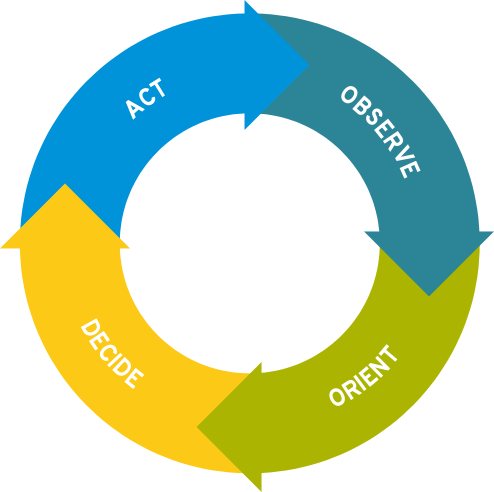
Simplified OODA loop. Boyd’s full model is more complex.
Boyd’s enduring genius (which emerged over time through several stages of his career), was to apply these ideas to areas far beyond dogfighting. The ability to observe, orient, decide and act faster than the competition is important in all kinds of activities, including national strategy, politics, economics and… finally, I’m getting to the point… managing a successful business.
In the 70s and 80s American military leaders started adopting “Boydian” concepts in a big way, changing lots of things – weapons design, acquisition processes, military doctrine, fundamental military structure – to speed up our own decision loops. Arguably, this change in strategic thinking allowed the U.S. to emerge from the Cold War as the world’s only hyper-power.
At about the same time, economists, business leaders and top-ranked biz schools started talking about fast decision cycles and ‘lean organizations’. Often, they specifically cited Boyd’s concepts on the OODA Loop, agility, maneuverability and ‘fast transients’. That’s still happening (see links below). It turns out the rules for dogfighting in jets work for business owners and managers too.
So here’s my basic point. Business is a competitive sport. If you’re a business owner or leader, you’re looking for an edge. You’re ‘maneuvering’ in the marketplace against other businesses to gain competitive advantage. As you turn and burn, you’ll do well to adopt the ideas of John Boyd, a ‘master of maneuver’ who taught a lot of people how to come out on top in any competitive environment:
- Observe. Gather data about your environment and the competition. Where are you? Where are your competitors? What are they doing?
- Orient. Analyze and synthesize the data. What are the competition’s advantages? What are your advantages? How can you exploit them?
- Decide. Figure out the best course of action based on the above. But information and analysis are useless without decision.
- Act. Decision is useless without action. Don’t wait for the mythical magic moment. Execute. Get it done.
Then repeat the cycle. And do it faster than your competitors. When you’re inside their OODA loop, you’ll know it.
–Ajax Trueblood
Get your organization to think and act like a fighter pilot –Chris Taylor
What’s in Your OODA Loop?– Matthew Fritz
Business Agility Fighter Pilot Style – Dave Roberts